What Is Crypto Market Making? How Institutional Liquidity Works
Crypto market making is what keeps digital asset markets functional — tightening spreads, deepening order books, and enabling efficient price discovery across fragmented venues. This article breaks down how market making works, why it matters, how institutional liquidity providers differ from retail participants, and how Raven delivers 24/7 liquidity across centralized and decentralized exchanges.
What Is Crypto Market Making? How Institutional Liquidity Works
Crypto market making is the process of providing liquidity to digital asset markets by continuously placing buy and sell orders on exchanges. Market makers ensure that traders can always find a counterparty, that bid-ask spreads remain tight, and that prices reflect genuine supply and demand. Without market makers, most crypto markets would suffer from thin order books, wide spreads, and sharp price swings that deter participation.
This article explains how crypto market making works, why it matters, and how institutional liquidity providers like Raven operate across centralized and decentralized venues.
How Crypto Market Making Works
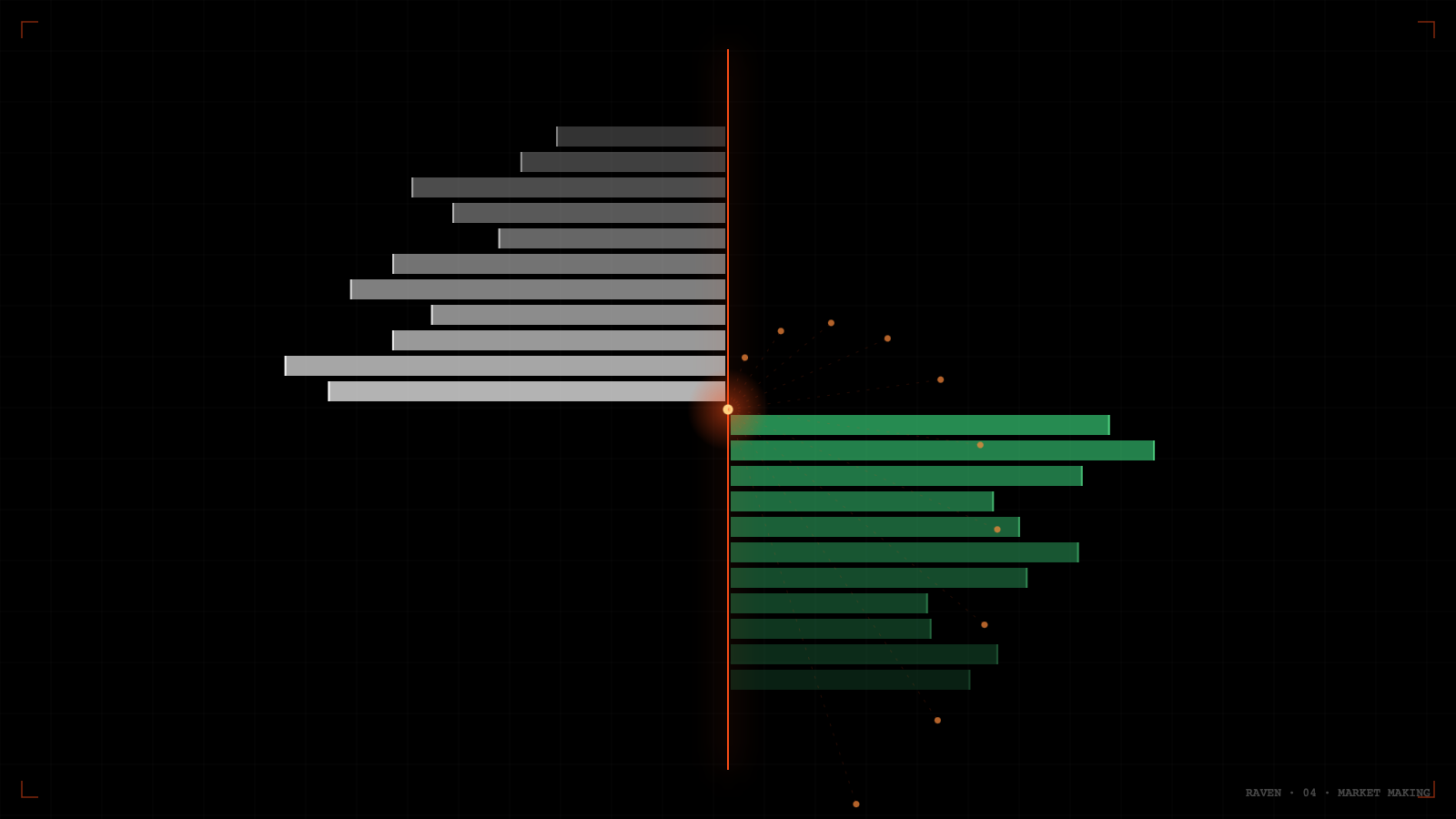
A market maker places simultaneous buy orders (bids) and sell orders (asks) for a given asset on an exchange. The difference between the bid price and the ask price is called the spread. When a market maker buys at the bid and sells at the ask, they capture that spread as profit.
For example, if a market maker quotes a bid of $99.50 and an ask of $100.50 for a token, they earn $1.00 each time both sides of the trade are filled. The market maker does not need the token's price to go up or down to profit. Instead, they aim to remain neutral, earning small amounts on each completed round trip while managing their inventory so they are not overexposed to price movements in either direction.
In practice, institutional market makers execute this process thousands of times per day across dozens of trading pairs and multiple exchanges simultaneously. The systems that power this activity are algorithmic, operating 24/7 with automated risk controls that adjust quotes in real time as market conditions change.
Why Crypto Markets Need Market Makers
Liquidity is what separates a functional market from a dysfunctional one. In a liquid market, a trader can buy or sell a meaningful position without significantly moving the price. In an illiquid market, even a modest trade can cause large price swings (known as slippage), discouraging participation and distorting price signals.
Market makers solve this problem by maintaining a continuous presence on both sides of the order book. Their activity provides several critical benefits to the broader market.
Tighter spreads. By competing to offer the best bid and ask prices, market makers narrow the gap between what buyers pay and what sellers receive. Tighter spreads reduce trading costs for all participants.
Deeper order books. Market makers add volume at multiple price levels, creating a buffer that absorbs large orders without dramatic price impact. This depth is what allows institutional traders to execute significant positions efficiently.
Price stability. Continuous quoting dampens the volatility that arises when buy and sell orders arrive unevenly. During periods of normal trading, market maker activity helps prevent erratic price jumps caused by temporary order imbalances.
Better price discovery. By processing information from multiple markets and adjusting their quotes accordingly, market makers help prices converge toward fair value more quickly. Cross-venue arbitrage, where a market maker buys on one exchange where an asset is underpriced and sells on another where it is overpriced, aligns prices across the fragmented crypto landscape.
How Institutional Market Makers Differ from Retail Liquidity Providers
While anyone can technically provide liquidity on a DEX or place limit orders on a CEX, institutional market makers operate at a qualitatively different level. The distinction matters because it directly affects the quality of liquidity available in a market.
Scale. Institutional market makers deploy significant capital across hundreds of trading pairs on multiple exchanges simultaneously. This breadth allows them to maintain liquidity even in less-traded markets and during periods of stress when retail liquidity providers typically withdraw.
Technology. Professional firms run proprietary algorithmic systems designed for high-frequency quoting, real-time risk management, and cross-venue execution. These systems process market data, adjust thousands of orders, and rebalance inventory continuously, far beyond what manual trading or simple bots can achieve.
Risk management. Institutional market makers employ sophisticated hedging strategies, and position limits. When markets move violently, these systems can widen quotes or pull liquidity to protect the firm's capital, then re-engage when conditions stabilize. This disciplined approach allows professional firms to provide liquidity consistently over long periods, including through bear markets, liquidation cascades, and black swan events.
Multi-venue coverage. The crypto market is highly fragmented, with liquidity spread across dozens of centralized exchanges, decentralized protocols, and Layer 2 networks. Institutional market makers operate across this entire landscape, linking fragmented pools of liquidity through cross-venue arbitrage and ensuring that prices remain consistent regardless of where a trade is executed.
How Raven Provides Institutional Liquidity
Raven is a proprietary algorithmic trading firm that provides institutional-grade liquidity across crypto, prediction markets, and traditional finance. Raven operates on every major centralized and decentralized exchange, including Binance, Coinbase, OKX, Hyperliquid, Gate.io, Bybit, and many others.
Raven's market-making infrastructure is built for the demands of institutional liquidity provision.
Low-latency, high-throughput systems. Raven's proprietary algorithms quote across dozens of venues simultaneously, processing market data and adjusting orders in real time. Our systems are designed for 24/7 operation with the reliability that exchanges, token projects, and trading partners require.
Cross-venue coverage. We provide liquidity across both CeFi and DeFi, covering major centralized exchanges and decentralized protocols. This multi-venue presence allows us to maintain consistent pricing, execute cross-venue arbitrage, and ensure deep liquidity wherever our partners' assets trade.
Rigorous risk management. Our systems incorporate automated position limits, and hedging strategies. This disciplined approach allows us to provide reliable liquidity through all market conditions, including the periods of extreme volatility when liquidity is most needed.
Partnership-driven approach. Raven works directly with token projects and exchanges through service level agreements (SLAs) that define clear liquidity targets, spread requirements, and performance metrics. We are focused on building long-term partnerships that align our interests with the success of the projects and platforms we serve.
Raven also extends its market-making expertise to prediction markets, serving as a liquidity provider on Polymarket and Kalshi, and as an exclusive launch partner for Gemini Predictions, Predict.fun, and Backpack Predictions.
Key Takeaways
Crypto market making is the process of providing liquidity by continuously quoting buy and sell prices on exchanges, earning the spread between bid and ask while maintaining a neutral market position.
Market makers improve market quality by tightening spreads, deepening order books, stabilizing prices, and enabling efficient price discovery across fragmented venues.
Institutional market makers differ from retail liquidity providers in their scale, technology, risk management capabilities, and multi-venue coverage.
The crypto market's institutional transformation, including the growth of ETFs, OTC trading, and regulated derivatives, has raised the bar for liquidity provision, favoring professional firms with the infrastructure to operate across the full landscape.
Want to talk markets?
Most of our deals start with a conversation about what your team actually needs. Schedule a short call!
Let's connect →